How Customer Experience Shapes B2B Buying Decisions
In many B2B industrial companies, marketing is still treated primarily as lead generation or brand awareness. But for organizations selling complex solutions with long sales cycles, marketing plays a much broader role.
Marketing shapes the customer experience long before a conversation with sales begins.
Research consistently shows that B2B buyers spend a significant portion of their journey researching independently. In fact, studies from 6sense show buyers complete around 70 percent of their buying journey before they ever speak with a vendor.
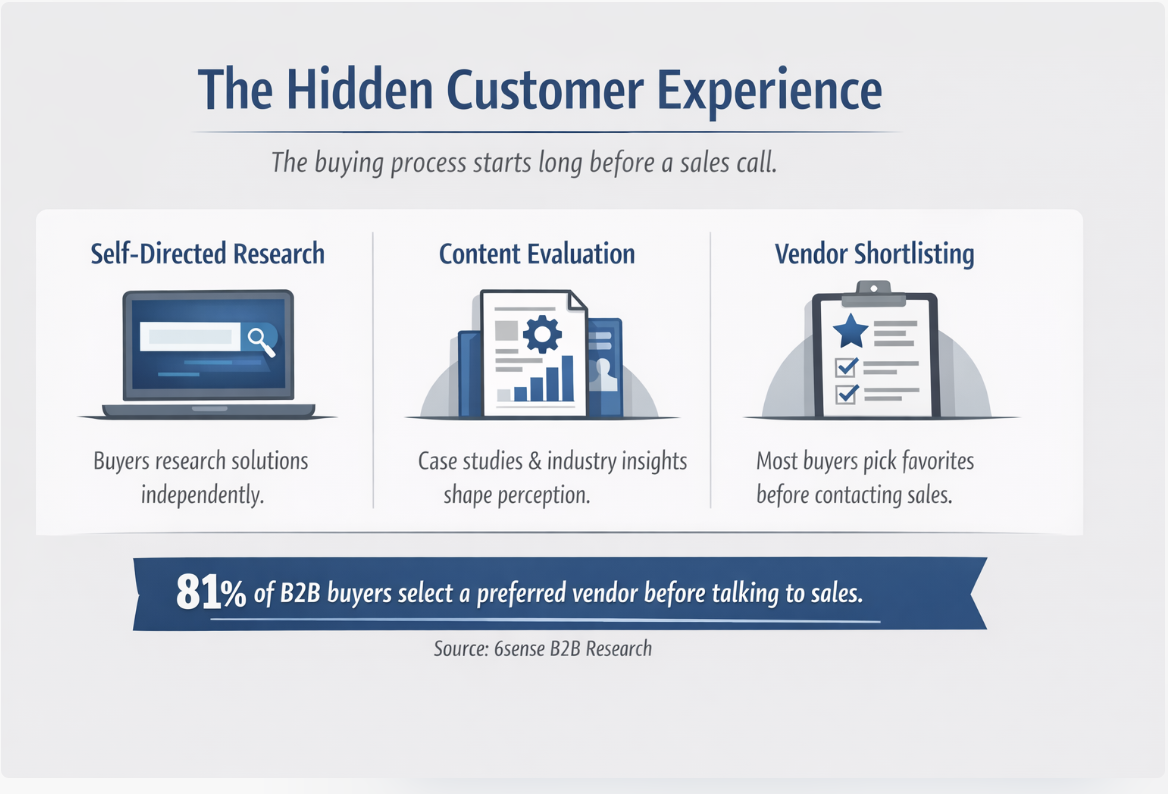
By the time a buyer contacts a company, they often already understand the market, have evaluated multiple vendors, and may even have a preferred partner in mind.
This reality changes how marketing should operate.
Marketing is no longer just about generating interest. It is about creating an experience that builds confidence early in the buying journey.
What Customer Experience Means in Industrial Marketing
In industrial sectors such as construction, engineering, and manufacturing, customer experience does not revolve around flashy campaigns.
It revolves around clarity, credibility, and accessibility.
Industrial buyers want to quickly understand:
• What problems do you solve
• Where your expertise lies
• How have you delivered results for similar projects
• Whether your organization can be trusted on high-stakes projects
Marketing helps deliver those signals through digital channels, technical content, and clear messaging that aligns with the real concerns of buyers.
The Digital Experience Is Now the First Experience
Most industrial purchasing journeys now begin online.
Engineers, procurement teams, and project managers research solutions through search engines, industry publications, and vendor websites long before reaching out.
Because of this shift, digital discoverability has become a core part of customer experience.
If buyers cannot easily find credible information about a company's expertise, that company may never enter the evaluation process.
This is where marketing plays a strategic role through:
• Search visibility and technical content
• Thought leadership and case studies
• Clear messaging about capabilities and outcomes
Customer Experience Continues Through Credibility
Once a company is discovered, buyers immediately begin evaluating risk.
Industrial projects involve large investments and operational impact, so buyers look for evidence that a company can deliver.
Marketing helps reduce that perceived risk by documenting and communicating:
• Past project outcomes
• Technical expertise
• Operational capability
• Industry perspective
In other words, marketing helps answer the buyer's core question:
Can this company actually deliver?
Examples From My Experience
Black & Veatch — Supporting the Energy Transition Narrative
While managing digital programs at Black & Veatch, I supported enterprise communications during the company’s transition toward renewable energy and advanced power solutions.
The work involved coordinating messaging across multiple business units and supporting executive communication on LinkedIn and digital channels.
By helping distribute technical insight and industry perspectives, the company was able to demonstrate its expertise to energy decision-makers researching infrastructure partners.
That type of early credibility shapes the customer experience before a formal engagement begins.
DH Pace — Making Expertise Visible Across Local Markets
At DH Pace Company, I worked within the marketing team supporting digital content and communications across dozens of local markets.
My work included developing search-optimized content across more than 35 regional websites and coordinating messaging across 75 social media accounts nationwide.
The goal was to ensure buyers researching building services and security systems could quickly understand the scale and capabilities of the organization.
That accessibility improved the experience for customers evaluating vendors online.
SFA Companies / BVA Hydraulics — Supporting Partner Experience Through CRM
In my current role as Marketing Director at SFA Companies, supporting the BVA Hydraulics product line, I shifted marketing efforts toward a stronger B2B strategy focused on distributors and industrial buyers.
Key initiatives included:
• Implementing CRM-driven partner nurture workflows
• Developing clearer product messaging for technical audiences
• Aligning marketing materials with distributor sales conversations
These improvements helped partners access clearer information about product capabilities and applications, contributing to 10 percent year-over-year sales growth in a competitive manufacturing market.
Why Customer Experience Is a Competitive Advantage
In industrial markets, many vendors offer similar capabilities.
The companies that stand out are often the ones that make it easier for buyers to understand and trust them.
Research shows how important this experience has become. According to a PwC study cited in industrial CX research, 86 percent of B2B buyers say they would switch suppliers for a better digital experience.
In other words, experience can become the deciding factor even when products or services are similar.
The Role of Marketing in Modern Industrial Growth
The organizations that win in complex B2B markets are not simply investing more in marketing.
They are designing marketing around the entire customer journey.
That means:
Helping buyers discover expertise earlier
Making technical knowledge easier to understand
Providing proof that reduces risk
Aligning marketing, sales, and leadership communication
When marketing supports the customer experience in this way, it becomes more than a promotional function.
It becomes a driver of trust, credibility, and long-term revenue growth.